top of page
Analyze. Architect. Automate.

Analyze. Architect. Automate.
Workflow Automation at Scale
Explore one of our real-world implementations.
Context
Enterprise operations relied heavily on manual communication, disconnected systems, and inconsistent process execution across security, HR, facilities, engineering, and internal support functions. Workflows were managed through email, standalone tools, and informal coordination, creating delays, gaps in visibility, and inconsistent outcomes.
Problem
Work did not move through the organization in a structured or reliable way:
• Incident escalation depended on single-recipient emails, delaying response
• No defined escalation paths, excluding key stakeholders
• SOP approvals operated in isolation without cross-functional input
• Facilities and engineering systems were disconnected with no automation
• Training, onboarding, and compliance tracking were manual
• Internal support lacked structured intake and tracking
As a result:
• Critical events were delayed or mishandled
• Communication was fragmented
• Processes varied across teams
• Leadership lacked visibility into execution
Approach
Using Role-Level Operational Analysis, workflows were mapped across:
• Security operations
• HR and onboarding
• Facilities and engineering
• Internal support services
Focus areas included:
• How work was initiated
• How it moved between teams
• Where delays occurred
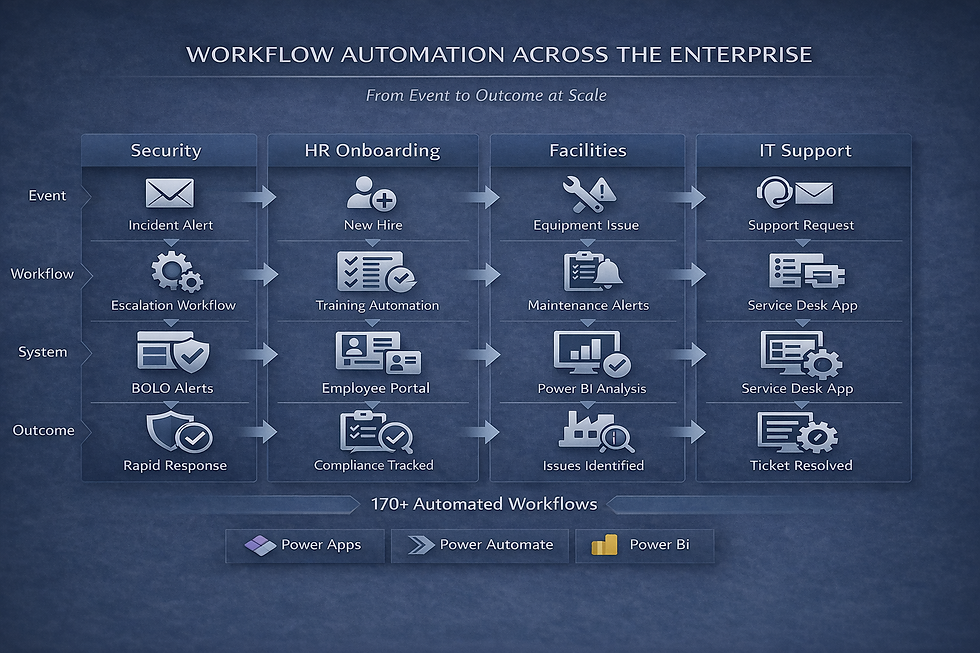
A unified event-driven automation model was designed to trigger, route, and execute workflows consistently across systems.
Solution
A scalable automation framework was built using Power Automate, SharePoint, Power Apps, and Power BI.
Key capabilities included:
• Automated incident escalation and notification
• SOP and approval workflow automation
• Facilities and engineering inspection automation
• BOLO and security alert integrations
• HR onboarding and training automation
• Certification tracking and alerts
• Internal support intake and ticketing system
Scale:
170+ automated workflows deployed across multiple business functions
Outcome
• Real-time escalation replaced delayed communication
• Consistent workflow execution across departments
• Reduced manual coordination
• Improved response times and efficiency
• Cross-functional visibility into operations
Automation evolved from isolated tasks into a coordinated operational system.
bottom of page